You’ve seen the label: “septic safe,” “breaks down like toilet paper,” “safe for plumbing.” It’s printed right there on the package in confident, reassuring font. So you flush the wipe, wash your hands, and go about your day without a second thought.
But plumbers across the country have a very different story to tell and they’re telling it with increasing urgency. The truth is that flushable wipes are one of the most common culprits behind clogged pipes, sewer backups, and costly emergency plumbing calls. And the problem isn’t just in your home. It scales all the way up to municipal sewer systems, where wipes contribute to massive blockages that cost cities millions of dollars to remove.
So are flushable wipes bad for plumbing? The short answer is yes and this guide will explain exactly why, what happens when you flush them, and what you can do instead.
What Are Flushable Wipes and Why Are They Controversial?
Flushable wipes are pre-moistened disposable cloths marketed as a step up from traditional toilet paper. They’re thicker, softer, and leave users feeling cleaner. Some are medicated with aloe or witch hazel for people managing skin conditions. Others target parents of young children, adults seeking better hygiene, or people with medical needs. By all appearances, they’re a modern bathroom upgrade.
The controversy begins with the word “flushable” itself. Technically, almost anything small enough can be flushed; it will clear the bowl and pass through the U-bend. But clearing the toilet is a very different thing from being safe for your plumbing system as a whole. The marketing language implies complete safety, while plumbing professionals consistently report the opposite.
How flushable wipes are marketed vs. how they actually perform
Packaging claims like “safe for sewer and septic systems” are not regulated by any federal authority in the United States. Manufacturers conduct their own internal flushability tests, which typically measure whether a product can travel through a standard toilet trap not whether it survives the full journey through residential pipes, municipal sewer lines, or septic tanks. Some brands, like Charmin, have invested in improved flushability testing and reformulated their products, but even the best-performing wipes on the market do not match toilet paper’s real-world disintegration behavior.
What materials flushable wipes are made from (polyester, polymers, blended fibers)
Unlike toilet paper, which is made almost entirely from plant cellulose, a material that breaks apart rapidly when wet flushable wipes are manufactured from a blend of synthetic and semi-synthetic materials. Common components include polyester fibers, polypropylene, and binding polymers that hold the wipe together and maintain its strength and texture when wet. These materials are chosen specifically because they resist breaking apart during use. The very property that makes wipes feel durable and effective is the same property that makes them dangerous to flush.
How flushability is tested – and why lab results differ from real-world plumbing
The primary industry standard for flushability testing comes from guidelines developed by the International Water Services Flushability Group (IWSFG) and the Association of the Nonwoven Fabrics Industry (INDA). These tests assess whether a product can pass through a toilet trap and travel short distances in a controlled pipeline environment. What they don’t simulate is the real-world complexity of a residential plumbing system: varying pipe diameters, sharp bends, grease buildup, aging infrastructure, and slow-moving sewer lines. A wipe that “passes” a lab flushability test can still accumulate in your pipes over weeks or months, eventually forming a clog that no plunger can dislodge.
Do Flushable Wipes Actually Break Down?
This is the central question and the answer is technically yes, but not nearly fast enough to matter. All organic materials break down eventually. The critical variable is how quickly that breakdown happens relative to your plumbing system’s ability to carry the material away safely. With toilet paper, the answer is seconds to minutes. With flushable wipes, it can be days, weeks, or longer and in some conditions, the breakdown process barely progresses at all.
How toilet paper dissolves vs. how flushable wipes behave in water
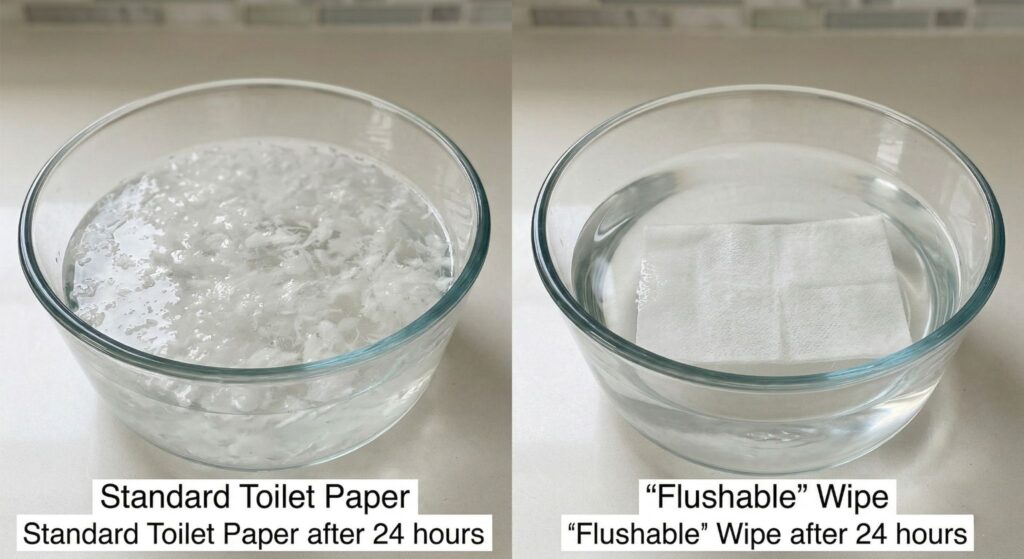
Standard toilet paper is engineered with a very specific structural weakness: it is designed to fall apart when exposed to water. The cellulose fibers are loosely bonded, and a brief soak causes those bonds to dissolve rapidly. In practical terms, toilet paper begins disintegrating within seconds of flushing and is largely broken down within a few minutes of traveling through water. Flushable wipes, by contrast, retain their structural integrity far longer. Their polymer and polyester construction means they stay together as a sheet even after extended time in water, which is why they can travel through a toilet trap intact and then sit in a pipe bend or septic tank as a nearly whole sheet.
Why “biodegradable” on the label doesn’t mean what you think
Some flushable wipes are marketed as “biodegradable,” which sounds reassuring but is largely meaningless in a plumbing context. Biodegradable simply means a material will break down through biological processes but it says nothing about how long that process takes. A biodegradable wipe might take months or years to fully decompose, during which time it is sitting in your pipe system, collecting grease and debris. Even wipes that use plant-based fiber components often contain synthetic binders that are far slower to degrade, meaning the wipe may partially break down while still retaining enough structural integrity to contribute to a blockage.
What research says about wipe disintegration rates in wet conditions
Research published in peer-reviewed wastewater management journals has consistently found that wipes marketed as flushable do not disintegrate to acceptable levels within the timeframes relevant to residential or municipal plumbing. One key finding across multiple studies is that wipes stored or transported in a wet medium which is exactly the condition they encounter in sewer pipes actually become less dispersible over time, not more. The moisture that might theoretically aid breakdown is offset by the compacting and tangling that occurs as wipes travel through pipes. Studies by organizations including the Water Research Foundation have found that wipes remain largely intact after multiple hours of agitation in lab conditions designed to simulate sewer travel.
What Happens to Flushable Wipes After You Flush?
The journey of a flushed wipe doesn’t end when it disappears from your toilet bowl. That’s actually just the beginning of the problem. Understanding what happens downstream from your home’s pipes to the wider municipal sewer system makes it much easier to understand why plumbers treat this issue with such seriousness.
How wipes travel through your home’s plumbing system
When you flush, the rush of water carries the wipe through the toilet trap and into your home’s drain line. In ideal conditions high water pressure, straight pipes, no existing buildup the wipe may travel all the way to the municipal sewer connection without incident. But most residential plumbing is far from ideal. Pipes have bends, narrowing joints, and sections where water flow slows. Cast iron or clay pipes in older homes may have rough interior surfaces where materials catch and accumulate. The wipe may clear the toilet, travel partway through your drain line, and then snag on a bend or rough surface, where it sits and waits for the next flush to push it further or to be joined by another wipe.
How wipes combine with grease and debris to form blockages
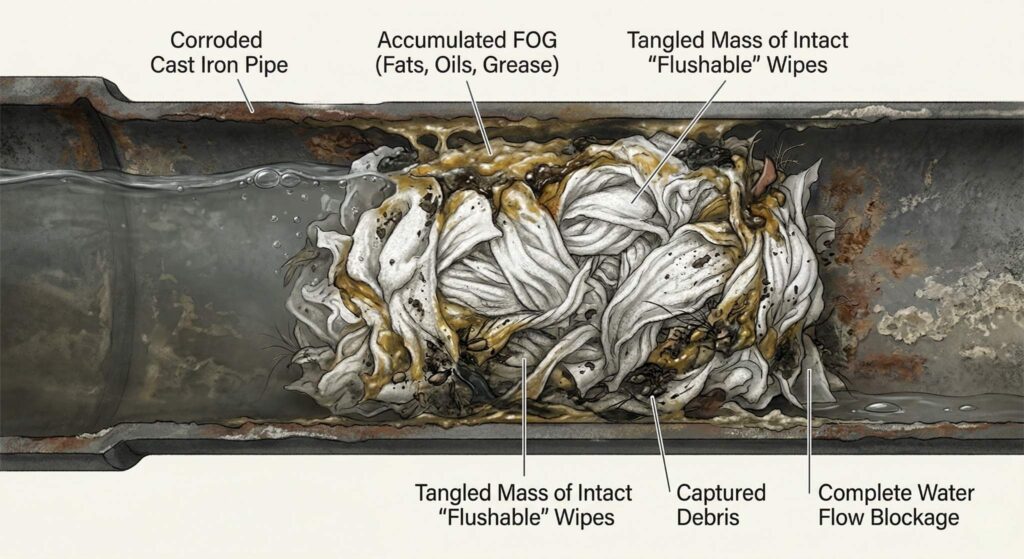
Wipes rarely cause problems in isolation. The real danger is their tendency to combine with other materials in your pipes. Cooking grease flushed or washed down kitchen drains coats the interior of pipes with a sticky film. Hair, soap scum, and personal care product residue accumulate in bathroom drain lines. When a wipe comes into contact with this greasy, debris-laden interior, it can adhere to the pipe wall or tangle with other wipes and solid materials, forming a mass that grows with every flush. Plumbers regularly describe pulling out clumps of wipes that have gathered everything from dental floss to small toys, bound together into a dense blockage that completely seals off a drain line.
What fatbergs are and why they’re a growing municipal problem
When wipes make it past your home’s plumbing and into the municipal sewer system, the problem doesn’t disappear it scales up dramatically. In city sewer mains, wipes combine with the fats, oils, and grease (FOG) that accumulate from thousands of households and businesses. Over time, this mixture congeals into what wastewater engineers call “fatbergs” enormous, rock-hard masses of congealed fat and non-biodegradable debris, held together primarily by flushed wipes.
The scale of the problem is staggering. In 2017, a fatberg discovered beneath the streets of Whitechapel in London weighed an estimated 130 metric tons and stretched over 250 meters requiring workers more than two months to break apart and remove. In the United States, the American Public Works Association estimates that municipalities spend over $1 billion annually clearing sewer blockages, with wipes identified as a primary contributing factor. New York City’s Department of Environmental Protection has reported spending upward of $18 million per year dealing with wipe-related sewer blockages. The COVID-19 pandemic made the problem worse: as wipe use surged and paper towels and face masks entered the waste stream alongside them, utilities across the country reported sharp increases in clog frequency and severity.
Signs that flushed wipes are causing a clog in your pipes
If you’ve been flushing wipes regularly, watch for these warning signs that a blockage may be forming:
- Toilets or drains that flush slowly or gurgle after flushing
- Unpleasant odors coming from drains, even after cleaning
- Water backing up in sinks, tubs, or floor drains when you flush
- Multiple drains in the home running slowly at the same time (a sign the clog is in the main line, not a branch line)
- Toilet water rising higher than normal before draining after a flush
Any combination of these signs warrants prompt attention. Clogs that are caught early are far easier and less expensive to clear than ones that have been compacting for months.
Are Flushable Wipes Bad for Every Type of Plumbing System?
Regardless of what type of plumbing system your home has, the answer is consistently the same: flushable wipes pose a risk. The nature and timing of the problem may vary slightly depending on your setup, but no plumbing configuration makes flushing wipes a safe practice.
Impact on standard residential sewer-connected plumbing
For the majority of homeowners connected to a municipal sewer system, the risk from wipes accumulates gradually. A single wipe flushed once may not cause a problem. But regular use over weeks and months creates a slow buildup in pipe bends, joints, and low-flow sections of your drain line. Because the damage is incremental, many homeowners don’t realize wipes are the cause of their plumbing problems until they’re facing an expensive service call. The age and condition of your pipes matters too newer PVC pipes have smoother interiors than older cast iron or clay pipes, but wipes can accumulate in any system given enough time.
Are flushable wipes safe for septic tanks?
Homes with septic systems face unique risks. A septic tank functions by separating waste into layers: solids sink to the bottom as sludge, liquids remain in the middle as effluent, and lighter materials float to the top as scum. Bacteria in the tank break down the solid sludge layer over time. When wipes enter this system, they do not break down the way organic waste does. Instead, they accumulate in the solid layer, accelerating the rate at which the tank fills. This means more frequent pumping typically every one to two years instead of the standard three to five which translates directly into higher maintenance costs. In severe cases, undissolved wipes can travel past the tank and into the drain field, clogging the distribution pipes and potentially requiring the entire drain field to be replaced, a repair that can cost $5,000 to $20,000 or more.
Risks in older pipes, shared plumbing, and apartment buildings
Older homes with cast iron, clay, or Orangeburg pipes face elevated risk because these materials degrade over time, developing rough, pitted interior surfaces where wipes catch more readily. In apartment buildings and multi-unit properties, shared drain stacks serve multiple units, meaning the wipes from one household can combine with grease and debris introduced by another, creating blockages in shared lines that affect every tenant. Property managers and building owners in older urban buildings frequently cite wipes as one of the top causes of plumbing maintenance calls. In these contexts, even occasional wipe flushing by a minority of tenants can create system-wide problems.
What About Baby Wipes, Makeup Wipes, and Other Disposable Wipes?
If “flushable” wipes are already problematic, wipes that make no flushability claims at all are significantly worse. Yet plenty of people flush them anyway either out of convenience or the mistaken belief that any small, soft product must be safe to flush.
Why non-flushable wipes are even more damaging than flushable ones
Baby wipes, makeup remover pads, antibacterial cleaning wipes, and similar products are manufactured to be even more durable than flushable wipes. They are designed to withstand significant friction and moisture without tearing, which makes them excellent for their intended purpose and catastrophic in a sewer pipe. These products typically contain a higher proportion of synthetic fibers and thicker construction than flushable wipes. They are, in practical terms, closer to a fabric cloth than to toilet paper. When flushed, they behave accordingly traveling through the toilet trap and then sitting largely intact in your drain line, where they are highly effective at catching other debris and forming blockages.
The full list of wipe types that should never be flushed
As a general rule, if it is not toilet paper, it should not be flushed. Specifically, none of the following should ever enter your toilet:
- Baby wipes and toddler wipes
- Makeup remover pads and facial cleansing wipes
- Antibacterial and disinfecting wipes
- Medicated wipes (including hemorrhoid wipes)
- Personal hygiene wipes and body wipes
- Pet grooming wipes
- Any wipe labeled “flushable” that is not toilet paper
The only item that should be flushed, beyond human waste, is toilet paper, preferably standard single or double-ply, which breaks down most reliably.
What to Do If You’ve Already Been Flushing Wipes
If you’ve been flushing wipes for weeks, months, or years without noticing a problem yet, you may be in better shape than you think – or you may already have a partial blockage forming. Here’s how to assess the situation and take action before a small problem becomes a major one.
Warning signs your pipes may already be affected
Slow drains are the most common early warning sign. If your toilet takes noticeably longer to clear after flushing, or if water drains slowly from your sink or tub, there may already be partial blockage forming in your drain line. Pay particular attention if multiple drains in the house are slow simultaneously this often indicates a clog in the main sewer line rather than a branch line, which is both more serious and more expensive to address. Gurgling sounds from drains, especially after flushing, are another red flag, as is any sewage odor coming from drains that cannot be explained by surface cleaning.
DIY steps to try first (plunger, toilet snake)
For minor clogs or slow drains that appear to be localized to one toilet or fixture, there are two DIY approaches worth attempting before calling a plumber. First, use a quality flange plunger (the type with an extended rubber flap designed for toilets, rather than a flat cup plunger) to create suction and attempt to dislodge the blockage. Apply firm, rhythmic pressure for 15 to 20 strokes before checking whether the drain has cleared. If plunging doesn’t resolve the issue, a toilet snake (also called a closet auger) can be fed into the drain to either break up the blockage or retrieve the material causing it. Many wipe clogs can be physically grabbed with the snake head and pulled back out. Be prepared to bag and dispose of the retrieved material – it will not be pleasant.
When to call a plumber – and what they’ll do to fix it
If DIY methods don’t clear the clog, or if your slow drain appears to involve multiple fixtures at once, it’s time to call a licensed plumber. A professional will typically begin with a drain inspection using a waterproof camera fed through the pipe, which allows them to identify the exact location, nature, and severity of the blockage. Depending on what they find, they may use a motorized drain auger to break up the mass, a hydro-jetting machine that blasts high-pressure water through the pipe to cut through grease and wipe buildup, or in severe cases, pipe excavation and replacement if the wipe accumulation has caused cracking or collapse in older pipes.
How much wipe-related plumbing repairs can cost
The cost of addressing a wipe-related plumbing problem varies significantly depending on the severity and location of the blockage. A straightforward drain snaking or hydro-jetting service typically costs between $150 and $500 for a residential line. If the blockage requires camera inspection to locate, add $100 to $300. If the clog has reached the main sewer line, costs rise to $300 to $800 or more for professional clearing. In worst-case scenarios where wipe buildup has contributed to pipe damage or failure particularly in aging cast iron systems, full pipe replacement can range from $1,500 to $15,000 depending on the length of pipe involved and whether excavation is required. By comparison, a bidet attachment costs $30 to $100 and eliminates the need for wipes entirely.
How to Get the Same Clean Feeling Without the Plumbing Risk
The good news is that there is no shortage of alternatives to flushable wipes that provide the same or better hygiene benefits without any of the plumbing risks. Whether you’re motivated by protecting your pipes, reducing your environmental footprint, or simply saving money over time, there’s a practical solution for every preference and budget.
Bidets and bidet attachments – a one-time investment that eliminates the problem
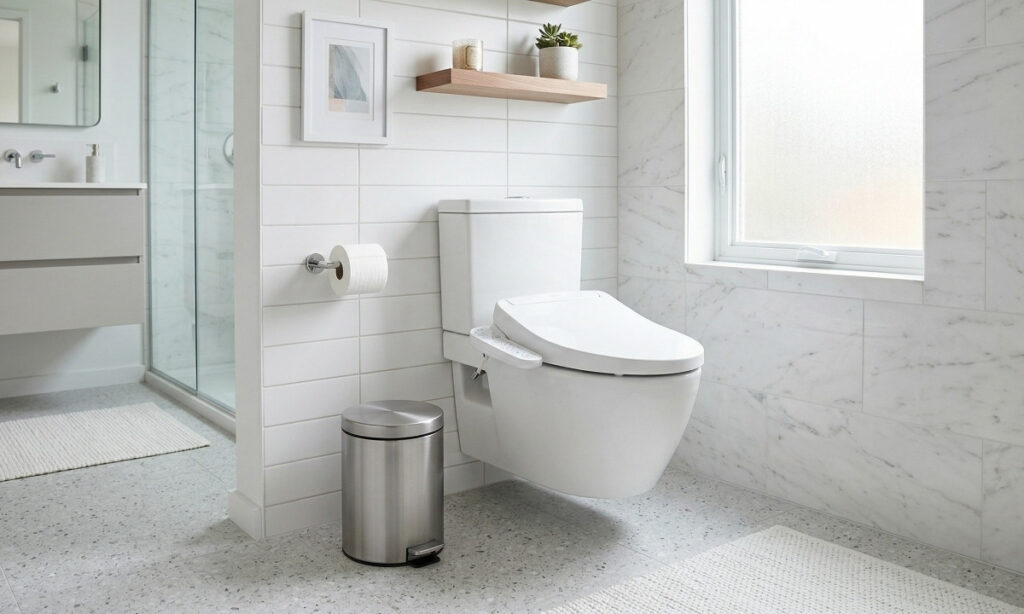
Bidets are standard fixtures in most of Europe, Asia, and South America, and their adoption in North America has grown significantly in recent years. A basic bidet toilet seat attachment which connects to your existing toilet’s water supply in under 30 minutes with no plumbing experience required retails for as little as $30 to $80 and provides a water-based clean that most users find superior to any wipe. Higher-end models with heated water, air dryers, and adjustable pressure cost $200 to $800 but eliminate the need for toilet paper as well as wipes. When compared against the cost of ongoing wipe purchases and the potential for expensive plumbing repairs, a bidet attachment typically pays for itself within a year.
Paper-based moist toilet tissue designed to dissolve safely
For those who prefer the wipe format but want a genuinely safe-to-flush option, paper-based moist toilet tissue is the only category that comes close to delivering on the flushability promise. These products distinct from fabric-based “flushable wipes” are manufactured from the same plant cellulose base as toilet paper, simply moistened with water and mild additives. Because the underlying material is cellulose, these products begin to break down in water much more quickly than fabric wipes. Look for products that are certified by the International Water Services Flushability Group (IWSFG) rather than relying solely on manufacturer claims.
Proper disposal – why the trash is always the right answer
If you choose to continue using wipes for any reason, the single most important habit change you can make is to dispose of them in a waste bin rather than the toilet. Keep a small, lidded trash receptacle next to your toilet for this purpose. It takes no more effort than flushing, costs nothing, and completely eliminates the plumbing risk. Most wipes are not recyclable due to their synthetic fiber content, so they will go to landfill which is far preferable to the environmental and infrastructure damage caused by introducing them to the sewer system. If odor is a concern, lidded bins with disposable or washable liners work well.
The Bigger Picture – Environmental Impact of Flushing Wipes
The damage caused by flushable wipes extends well beyond your home’s plumbing. When wipes enter the sewer system and eventually reach waterways whether through sewer overflows, treatment plant effluent, or direct littering they introduce a significant source of environmental contamination that is only beginning to be fully understood.
Microplastics and waterway contamination from flushed wipes
The synthetic fibers in flushable wipes polyester, polypropylene, and related polymers do not biodegrade in the natural environment. Instead, they fragment over time into microplastics: particles smaller than 5mm that are now detectable in rivers, oceans, drinking water supplies, and even the human bloodstream. A 2021 study published in the journal Environmental Science and Technology found that wet wipes were among the most commonly identified sources of microplastic contamination in riverbed sediments in the United Kingdom. Wipes that reach coastal or freshwater environments can also entangle aquatic wildlife and introduce chemical additives including preservatives, fragrances, and antibacterial agents into sensitive ecosystems.
Why flushable wipes are an environmental concern beyond your pipes
Even wipes that are successfully intercepted by wastewater treatment plants contribute to environmental problems. Most treatment facilities filter out solid material as sewage sludge, which is then either incinerated, landfilled, or applied to agricultural land as biosolids. Wipes and their synthetic fiber content end up in whichever of those waste streams the facility uses, introducing synthetic materials into the environment through a secondary route. The energy and chemical costs of processing wipe-laden sewage are also significant: utilities that deal with high volumes of wipe-related blockages must run additional equipment, use more cleaning chemicals, and dispatch maintenance crews more frequently, all of which has a carbon and resource cost.
What regulators and municipalities are doing about the problem
Regulatory pressure on the wipes industry is growing. In 2023, the United Kingdom passed legislation requiring all products labeled as “flushable” to pass stricter independent testing standards before they can use that designation on packaging a move welcomed by water utilities and environmental groups. In the United States, the Federal Trade Commission has investigated and taken action against some wipes manufacturers for misleading “flushable” claims, though a comprehensive federal labeling standard does not yet exist. Several U.S. cities and water utilities have launched public awareness campaigns explicitly advising residents to never flush wipes, regardless of labeling. The Water Environment Federation and the American Public Works Association have both published guidance calling for stronger industry standards and consumer education. Consumer class action lawsuits against wipes manufacturers have also increased, with several cases resulting in settlements or product reformulations.
FAQ – Flushable Wipes and Plumbing
Are there any flushable wipes that are actually safe to flush?
No wipe product currently on the market can be considered fully safe to flush in the way that toilet paper is. Some paper-based moist toilet tissues come closest, particularly those certified by the IWSFG, but even these should be used sparingly and are not recommended for homes with older plumbing, slow-moving drain lines, or septic systems. The most honest answer from any plumber is: if it is not toilet paper, do not flush it.
How long does it take for flushable wipes to cause a clog?
There is no fixed timeline; it depends on the volume of wipes flushed, the condition and layout of your pipes, and what other materials are present in your drain system. Some homeowners flush wipes for years before experiencing a problem; others encounter a clog within weeks. In general, regular flushing of one or more wipes per day in a system with any grease buildup or pipe irregularities can produce a noticeable clog within one to six months. The absence of symptoms does not mean the pipes are clear, it may simply mean the buildup has not yet reached a critical mass.
Can one flushable wipe clog a toilet?
A single wipe is unlikely to cause a complete clog in a healthy, properly functioning plumbing system but it is not impossible, particularly if there is already some degree of buildup in the pipes or if the wipe catches on a rough pipe interior. More commonly, a single wipe is the final piece that completes a developing blockage that already exists from weeks or months of flushing. Think of it less as “one wipe causes a clog” and more as “one wipe adds to a clog that is already forming.”
Are flushable wipes safe if I have a newer plumbing system?
Newer PVC plumbing has smoother interior surfaces than older cast iron or clay pipes, which does reduce but does not eliminate the risk from flushable wipes. The primary problem is not pipe texture but the fact that wipes do not disintegrate in water. Even in perfectly smooth, brand-new pipes, wipes can accumulate at bends, low-flow sections, and connections. A new plumbing system also connects to the same municipal sewer infrastructure as older systems, meaning the wipes will continue their journey through aging public pipes where they can contribute to fatbergs and blockages regardless of the condition of your home’s internal plumbing.
What is the safest way to dispose of flushable wipes?
The safest disposal method is the trash. Place a small, lidded bin next to your toilet, use wipes as you normally would, and deposit them in the bin rather than flushing them. This eliminates all plumbing risk, all environmental contamination risk, and all municipal infrastructure burden. Since most wipes are not recyclable due to their synthetic fiber content, they will go to landfill which, while not ideal from an environmental standpoint, is vastly preferable to introducing them to the water system.
Conclusion
The verdict on flushable wipes is clear, and it has been for some time: they are not safe for your plumbing, regardless of what the packaging claims. From the synthetic fibers that resist breaking down, to the grease-and-debris blockages they form in residential pipes, to the enormous fatbergs they contribute to in municipal sewer systems, flushable wipes cause real and measurable harm at every scale to your home, your wallet, and the broader water infrastructure that serves your community.
The rule is simple: flush only toilet paper and human waste. Everything else wipes of any kind, paper towels, feminine hygiene products, cotton pads belong in the trash. If you want the hygiene benefits that wipes provide, a bidet attachment is a one-time investment that costs less than a year of wipe purchases and delivers a better clean with zero plumbing risk.
Regulatory momentum is building on both sides of the Atlantic to hold wipes manufacturers accountable for misleading flushability claims, and consumer awareness is growing. But the most effective protection for your plumbing starts with a single habit change: keep a waste bin next to the toilet and use it.
If you’ve already been flushing wipes and are noticing slow drains, gurgling sounds, or backups, don’t wait for the problem to worsen. Contact a licensed plumber for a camera inspection of your drain lines catching a developing blockage early is significantly cheaper and less disruptive than dealing with a full sewer backup or pipe failure down the line.